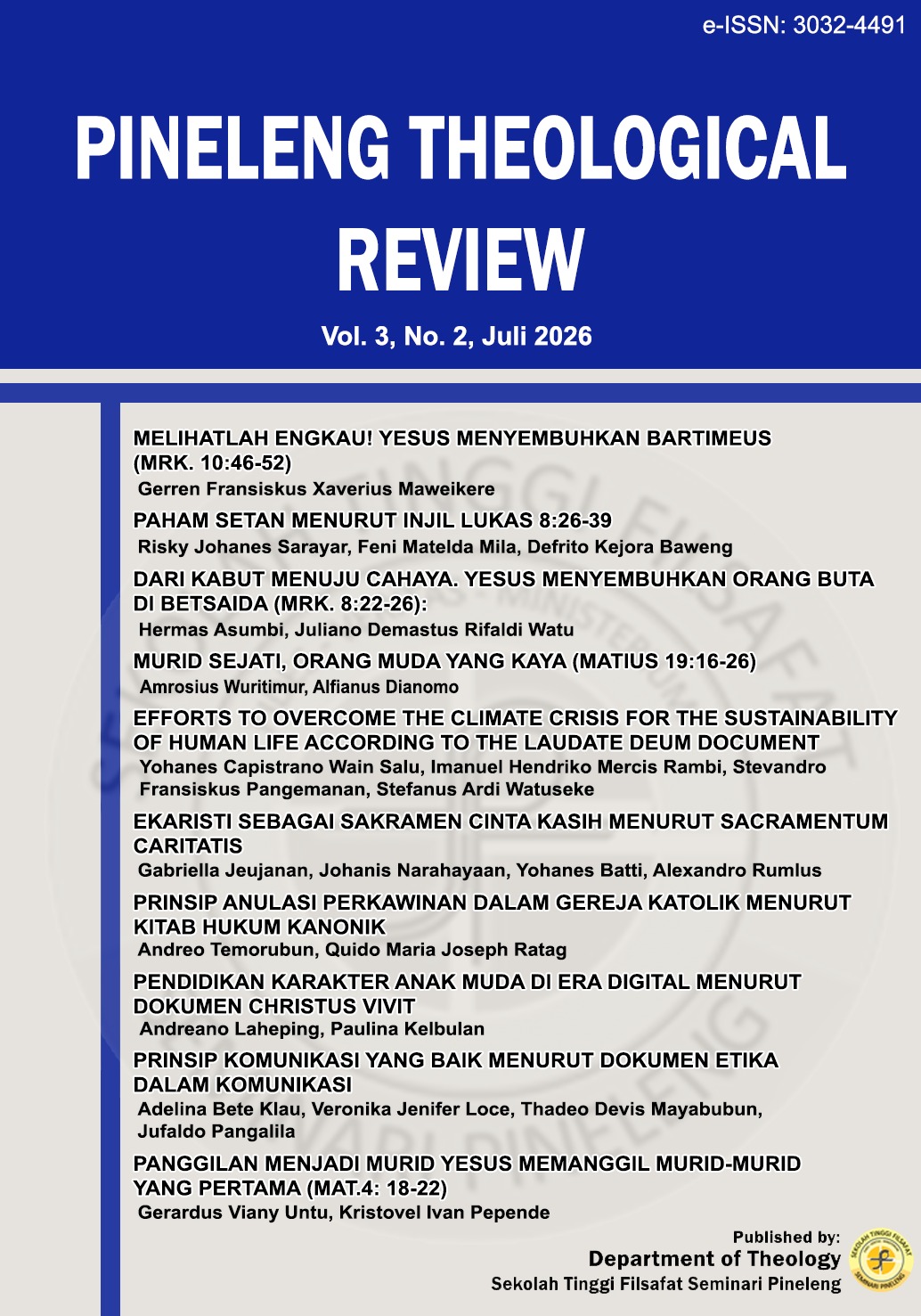
DARI KABUT MENUJU CAHAYA
Yesus Menyembuhkan Orang Buta di Betsaida (Mrk. 8:22-26)
DOI:
https://doi.org/10.53396/pthr.v3i2.874Keywords:
Jesus; healing of the blind man; faith; communal faith; BethsaidaAbstract
The healing of the blind man at Bethsaida (Mark 8:22–26) is a unique miracle narrative in the Gospel of Mark as it presents a gradual healing process. This article aims to holistically interpret the passage by integrating textual analysis, socio-historical context, and theological reflection. Through an exegetical approach, it demonstrates that this story occupies a vital narrative position as a transitional text preceding Peter's confession, while serving a symbolic function to portray the progressive enlightenment of the disciples' faith and spiritual blindness. The textual analysis highlights the two-stage healing structure, the use of symbolic language, the "Messianic Secret" motif, and the role of the community in bringing the blind man to Jesus, emphasizing faith as a communal experience. A study of the socio-historical context reveals Bethsaida as a simple fishing community with strong religious and social dynamics, indicating that this miracle impacted not only the individual but also the community's structure. From a theological perspective, the gradual healing is interpreted as a faith transformation process encompassing physical, spiritual, psychological, and social dimensions. Thus, Mark 8:22–26 is understood not merely as a miracle report, but as a theological laboratory affirming that faith is a progressive, communal, and transformative journey—offering lasting relevance for the Church in guiding believers toward a living, reflective faith.