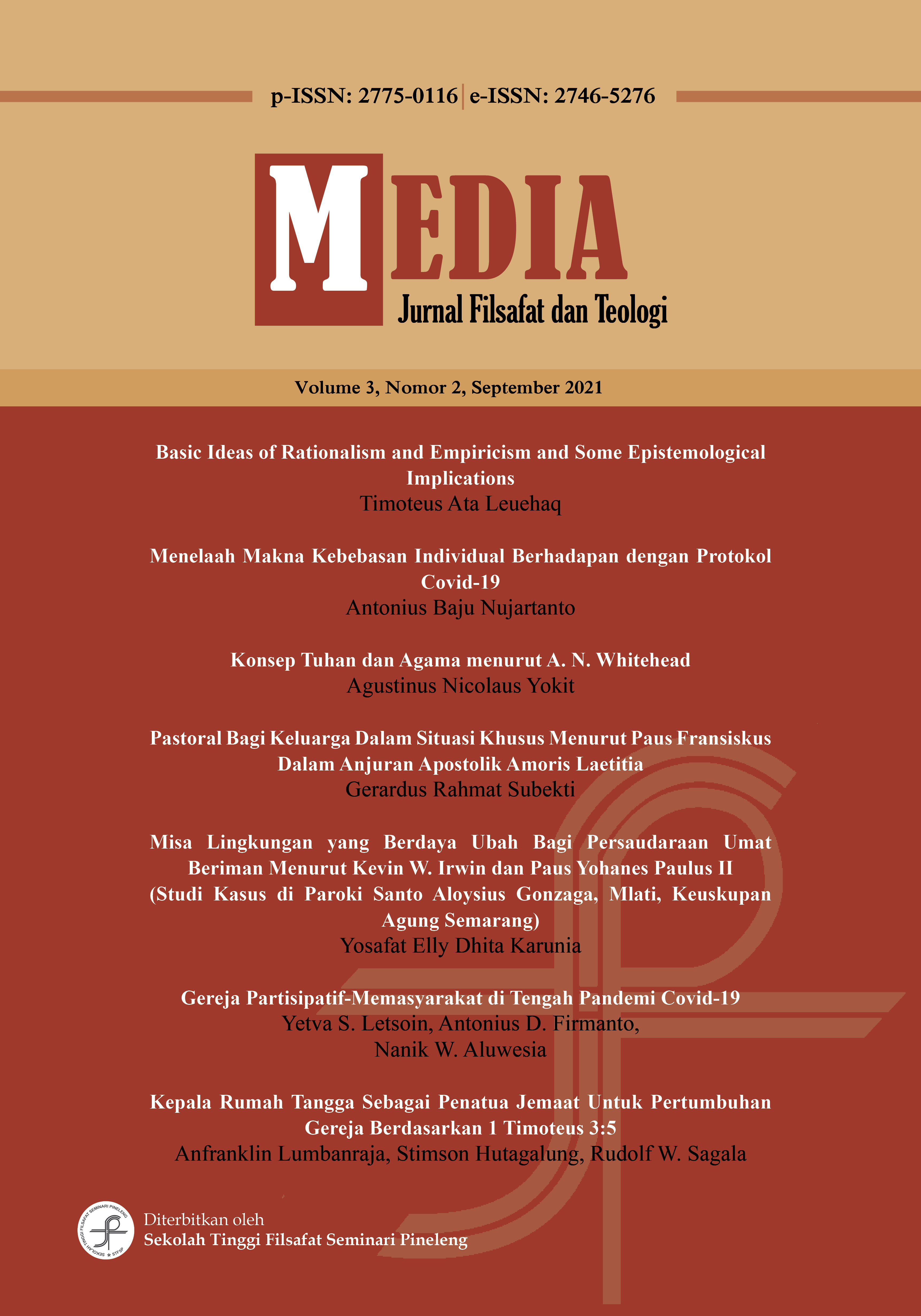
Konsep Tuhan dan Agama Menurut Alfred North Whitehead
DOI:
https://doi.org/10.53396/media.v3i2.37Keywords:
Proses, Materialisme Ilmiah, Satuan-satuan Aktual, Yesus Kristus, Tuhan, Dua kutub hakikat Tuhan, AgamaAbstract
This article discusses the concept of God and religion according to Alfred North Whitehead's process philosophy. The main issue is how to describe Whitehead's concept of God and its implications for religious life. Whitehead's critique of scientific materialism is an entry point to understand the characteristics of his thought. This criticism leads to Whitehead's cosmology in which each actual entity is in the process of becoming. God is not excluded from this cosmological scheme. In this way of thinking, God is the source of eternal objects or values. God experiences every actual event that occurs in the temporal world. Thus, God can be understood from two perspectives: the former refers to a cosmological frame, while the latter refers to religious experience. In Whitehead's language, God has two distinct natures, a primordial nature, and a consequent nature. From the perspective of religious life, Whitehead's concept of God seems to put more emphasis on divine immanence.
Downloads
Published
How to Cite
Issue
Section
License
Copyright (c) 2021 Agustinus Nicolaus Yokit

This work is licensed under a Creative Commons Attribution 4.0 International License.