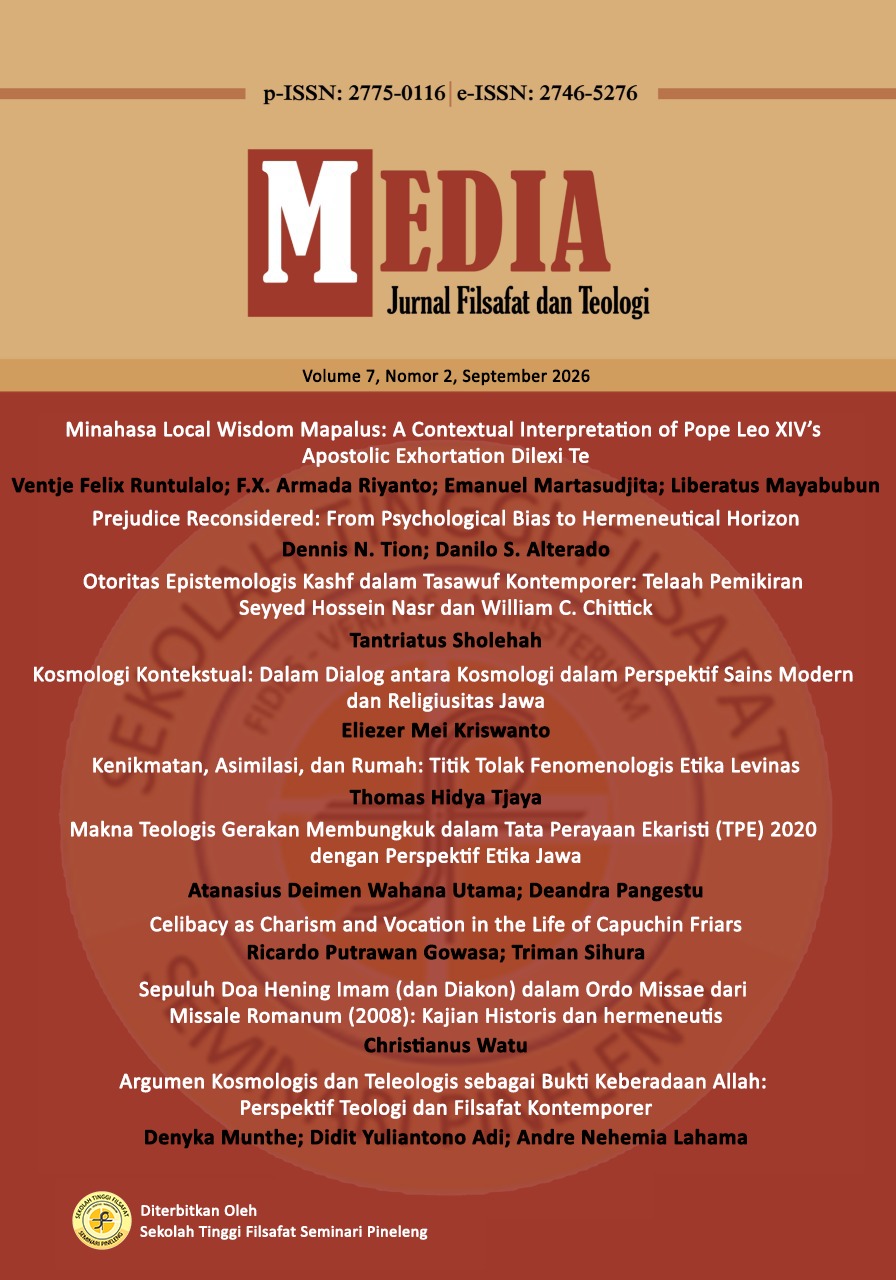
Kenikmatan, Asimilasi, dan Rumah: Titik Tolak Fenomenologis Etika Levinas
DOI:
https://doi.org/10.53396/media.v7i2.926Keywords:
Levinas’s ethics; Phenomenology; Enjoyment; Assimilation; Home; The face of the otherAbstract
Levinas’s ethics of responsibility is often placed and discussed in comparison with other ethical theories such as Immanuel Kant’s deontological ethics and John Stuart Mill’s utilitarianism. Unlike Kant who emphasizes the fulfillment of moral duty and Mill who employs the greatest happiness principle, Levinas is said to focus on responsibility toward the Other. On this view, the difference between Levinas’s ethics and traditional ethical theories concerns merely a particular ethical principle. This comparison overlooks Levinas’s phenomenological background, which analyzes primordial experience and the concrete meaning of human relations. The present article seeks to demonstrate that Levinas’s ethics must be understood within the context of a phenomenological analysis of the fundamental and natural movement of human beings in relation to the world and its objects. It employs the phenomenological method that involves the textual analysis of his works, particularly Totality and Infinity, through the concepts of enjoyment, assimilation, and dwelling. The resistance of the face of the Other emphasized in Levinas’s ethics constitutes a response to this fundamental movement expressed in activities of mastery and domination. This study offers a new perspective on Levinas’s ethics by showing its phenomenological point of departure.
References
Arnswald, Ulrich. “The Hidden Anthropological Aspect Of Emmanuel Levinas's 'Face Of The Other' In Context Of The Holocaust: A Case Of Applied Political and Legal Philosophy, Labyrinth Vol. 27, No. 2 (Winter 2025): 60-86. https://doi.org/10.25180/lj.v27i2.
Atterton, Peter et al., Levinas and Buber: Dialogue and Difference. Pittsburgh: Duquesne University Press, 2004.
Bergo, Bettina. Levinas between Ethis and Politics: For the Beauty that Adorns the Earth. Pittsburgh: Duquesne University Press, 2003.
Burggraeve, Roger. The Wisdom of Love in the Service of Love: Emmanuel Levinas on Justice, Peace, and Human Rights. Milwaukee: Marquette University Press, 2002.
Chalier, Catherine Chalier. What Ought I to Do?: Morality in Kant and Levinas. Translated by Jane Marie Todd. Ithaca: Cornell University Press, 2002.
Critchley, Simon and Robert Bernasconi (eds.). The Cambridge Companion to Levinas. Cambridge: Cambridge University Press, 2002.
Critchley, Simon. The Ethics of Deconstruction. Oxford: Blackwell, 1992.
Derrida, Jacques. Writing and Difference. Translated by Alan Bass. Chicago: The University of Chicago Press, 1978.
Gozum, Ivan Efreaim A. and Chastene Christopher D. Flake. “Encountering the Other in the Digital Sphere: Emmanuel Levinas’ ‘Ethics of the Face’ and the Implications for Virtual Healthcare Ethics in Contemporary Society.” Journal of Religion and Health (2025). https://doi.org/10.1007/s10943-025-02336-0.
Hanlon, Sheldon. “From Existence to Responsibility: Restlessnes and Subjectivity in the Early and Late Levinas.” Philosophy Today 55, 3 (2011): 282-297.
Imran, Muzzamel Hussain, “Responsibility toward the “Other”: A Critical Examination of Levinas's Ethical Philosophy,” Metaphilosophy, Volume 56, Issue 5 (2025): 551-567.
Levinas, Emmanuel. Alterity and Transcendence. Translated by Michael B. Smith. New York: Columbia University Press, 1999.
_______________ . Collected Philosophical Papers. Translated by Alphonso Lingis. Pittsburgh: Duquesne University Press, 1998.
________________. Discovering Existence with Husserl. Translated by Richard A. Cohen and Michael B. Smith. Evanston, IL: Northwestern University Press, 2000.
________________. Entre Nous: Thinking-of-the-Other. Translated by Michael B. Smith and Barbara Harshav. New York: Columbia University Press, 1998.
________________. Ethics and Infinity : Conversations with Philippe Nemo. Translated by Richard A. Cohen. Pittsburgh: Duquesne University Press, 1982.
________________. Is It Righteous To Be?: Interviews with Emmanuel Levinas. Edited by Jill Robbins. Stanford: Stanford University Press, 2001.
________________. Of God who Comes to Mind. Translated by Bettina Bergo. Stanford: Stanford University Press, 1998.
________________. Otherwise than Being or Beyond Essence. Translated by Alphonso Lingis. Pittsburgh: Duquesne University Press, 1998.
________________. Outside the Subject. Translated by Michael B. Smith. Stanford: Stanford University Press, 1993.
________________. The Theory of Intuition in Husserl’s Phenomenology, second edition. Evanston, IL: Northwestern University Press, 1998.
________________. Totality and Infinity: An Essay on Exteriority. Translated by Alphonso Lingis. Pittsburgh: Duquesne University Press, 1969.
Liu, Lewis. "Lévinas’s Philosophy of the Face: Anxiety, Responsibility, and Ethical Moments that Arise in Encounters with the Other" Human Affairs 34, no. 3 (2024): 440-459. https://doi.org/10.1515/humaff-2024-0021.
Peperzak, Adriaan T., ed. Ethics as First Philosophy: The Significance of Emmanuel Levinas for Philosophy, Literature and Religion. New York and London: Routledge, 1995.
Perpich, Diane. “Ethics as the Task of Being Human,” Labyrinth Vol. 27, No. 2 (Winter 2025): 27-43. https://doi.org/10.25180/lj.v27i2
Strasser, Stephan. “Emmanuel Levinas: Phenomenological Philosophy,” translated by H. Spiegelberg. In The Phenomenological Movement: A Historical Introduction. Edited by Herbert Spiegelberg, third revised and enlarged edition. The Hague: Martinus Nijhoff Publishers, 1984.
Tjaya, Thomas Hidya. Emmanuel Levinas: Enigma Wajah Orang Lain, cetakan kedua. Jakarta: Kepustakaan Populer Gramedia, 2018.
_________________. Fenomenologi sebagai Sains Pengalaman. Jakarta: Kepustakaan Populer Gramedia, 2025.
Wolff, Ernst. Political Responsibility for a Globalised World: After Levinas’ Humanism. New Brunswick, NJ: Transaction Publishers, 2011.
Downloads
Published
How to Cite
Issue
Section
License
Copyright (c) 2026 Thomas Hidya Tjaya

This work is licensed under a Creative Commons Attribution 4.0 International License.